Monday, May 23, 2016

Books Are Back!


I recently read an article in The Guardian, May 13, 2016: "Books are back. Only the technodazzled thought they would go away", by Simon Jenkins. It made me gloat.

Damn well, books are "back". They never left me in the first place!

It is one thing reading the news online, which I do and enjoy; but reading a book online has never appealed to me.
The news are made for the digital age: there is always something happening, the news are immediate, in the moment.  And the moment passes quickly. Ephemeral is the moment. Ronsard made sure of explaining it to us in verse,didn't he?

A book is made for duration, for lasting. A book is like a relationship: you love it or hate it; it leaves you thrilled, inspired or mitigated. You can come back to a book you read many years ago and still read something new, because you have evolved and read this same book with a different set of mind.  I re-read books all the time.  

At the same time I read new books. I notice a long-time favorite author 's writing evolution or his/her internal transformation, just like one would of a friend. I read new writers also because I like making new friends.
A book has a smell, like a person. It has a texture, like a person's skin. Different publishers make for different  smells, fonts, paper...

A book you hold in your hands, you take in your arms, you fall asleep with or stay awake with.  A book is one's lover, the only faithful relationship in your life, the only one where the dialogue, albeit silent, between the words on the page and your intimate self is permanent, understanding, never incriminating.

Even a book you do not enjoy now will teach you something about yourself. You may even re-read it later and find an echo that did not exist before when you first read it.

A book is for keeping. In paper. On your shelves.

Friday, January 15, 2016

An American Pentastich

Don't think, don't think, don't think.
Don't dream, don't hope, don't speak.
Don't say, don't tell, don't write.
Don't feel, don't feel, don't love.

Being and Nothingness is more than a title.

Saturday, September 5, 2015

Summer 2015 Readings

Mid-August I "attacked" Karl Ove Knausgaard's My Struggle (volume 1 of 6). 

I discovered him after reading his Part 1 and Part 2 article in the NYT's Magazine and then a friend's Danish husband mentioned him again when we had dinner and that brought back the enjoyment I felt while I read the long NYT Magazine article . 

Knausgaard is The Proust of Scandinavia and he keeps you entertained and thinking all the while. He is a fairly dark tormented author (not enough sun maybe?) but his style is so delectable... All the 6 volumes focus only on him, they are his "memoirs", a sort of Proust's La Recherche, but with fewer socialites. "As I sit here, I recognize that more than thirty years have passed.";  "When I was at home on my own, every room had its own character, and though not directly hostile to me they were not exactly welcoming, either." Read further: "Writing is drawing the essence of what we know out of the shadows. That is what writing is about. Not what happens there, not what actions are played out there, but the there itself. There, that is writing's location and aim. But how to get there?" BTW, Knausgaard has read Proust and studied French! Of course, the title is a bit of a shocker (Hitler's My Struggle, anyone?) and I am sure the author intended to shock. I am half-way through volume 1 and  will report later on the other volumes.

I also read Per PettersonAshes in my mouth, Sand in my shoes
Another Scandinavian favorite of mine. 
Written solely in the point of view of Arvid (a young boy), it is a collection of short chapters/stories that thread together like a novella on coming-of-age situations from age 5 to 13. Great character descriptions of the adult world around him too. Unusually "light" for another somber author (Out Stealing Horses (2005), To Siberia), but it was in fact its first published book in 1987, just finally translated into English in 2015!

 I read Soumission (in French) by Houellebecq and cannot recommend it enough. Please forget any literary reviews that you may have read when the book was released, which was just a couple of days after the Charlie Hebdo/ Hypercacher supermarket attack. Houellebecq had NOT planned the attack and is NOT a racist. Houellebecq is like a prophet preaching in the desert: no one listens to him or takes him/ his visions or his preaches seriously. The book is more a futuristic and political satire than anything else and for once, not as rude or crude than his previous works in which he denounced sexual tourism (but everyone ended up thinking he was a pervert or a "vieux degueulasse"... which proves that people either did not read him at all - or not properly-  or understood everything literally). I'll say that Houellebecq is more of a very depressed, hopeless man than a pervert or a racist. He denounces our weaknesses and includes himself in the lot. He has no hope for humanity. I am not far behind in thinking the same way, especially after the events in Europe and the Mediterranean sea in the last few days and weeks. For full disclosure: I bought the book in January in Paris, two weeks after the Charlie Hebdo event which was also two weeks after its release, while I was attending the Fondation AF Colloque. I read the first chapter and stopped because it was SO GOOD that I told myself I first needed to re-read Huysmans (a late 19th century / beginning of 20th century writer who is somehow a character in the book)... whom I had last read in 2009... I ended up reading some of Huysmans' pages from a couple of his novels between February and June and then grabbed Soumission on a Sunday in July and read it in one day, it is THAT good!


I also read, (in French too), a couple of really tender and funny (YES!) books by an Icelandic female writer, Audur Ava Olafsdottir. I highly recommend: Rosa Candida and also L'Embellie. One feels much better after reading these two books + you get to discover Iceland! Might prove useful when stopping there on the way back to Paris from DC on Iceland Air or Wow Air. I love the design of the cover of the English version of L'Embellie... translated into Butterflies in November by the brilliant Pushkin Press. A good pun on "butterflies in my stomach". A chance acquisition at a Used Book Sale put this author in my hands. My advice: always browse Used Book Carts. You never know what treasure you are about to find!


I read Elena Ferrante'Troubling Love last week. Ferrante is an Italian female writer, from Naples. Talk about a tormented writer!  Highly recommend her though, terrific style. Plus the translators at Europa Editions are the best in the world...Oh, and BTW, seems like people are whispering that Ferrante and Knausgaard are the current Titans of World Literature! Not surprised really. With sentences such: "I anchored myself to the paving stones of the piazza with the sole of my shoes."  or "I had sat for a while tasting my name like an echo of memory, an abstraction that sounds without sound in one's head." or also: "Amalia had the unpredictability of a splinter, I couldn't impose on her the prison of a single adjective.", her sentences are the strongest and the most beautiful I have read by far (apart from Knausgaard) this year.


In June I mentioned  Thomas Friedman's From Beirut to Jerusalem to a few French friends. 
Tom Friedman is a journalist...
at The New York Times, probably one of the most brilliant ones there is. He was the NYT Correspondent in Lebanon in the 1980s and then in Jerusalem. If you get the book, make sure you get the second edition (2012)... I hope he will release another edition in the next coupe of years, in light of the Arab Spring and its surprising consequences, the rise of ISIS, the destruction of the cradle of humanity (Syria... My heart cries when I think of Aleppo, of Palmyra...) and the likes... But at least I keep up with him as he writes in the NYT. His most recent article two days ago on why people who are against the Iran Deal have probably slept through 9/11 and forgotten that the US's worst BFF is Saudi Arabia is the BEST Editorial on the subject ever. 

My advice: Follow Tom Friedman on Twitter and in the NYT for the best analysis on the Middle East!

I invite everyone to read (for those who have not.. yet!) and re-read (for fans of the books and of the TV show like me, but the books first...) GoT (Game of Thrones, for the uninitiated). 
There are 5 volumes so far. I concede volume 3 is the least entertaining but is necessary to understand what went on, is going on and might happen. I am still feverishly awaiting the release of volumes 6, 7 and 8. I just hope the author does not die before he's finished writing (Valar Morghulis, I know... I know...). If you wonder why I write this, check his picture out! George R.R. Martin is his name. I salute his fertile imagination, this guy is a true story-teller. I hang onto his every page!


A former Washingtonian and a friend, Maryline Gauthier has just published her first book. Well, Maryline and I and a couple of others have been in the same writing group (a virtual group now... we send each other our writings since we all live in different places/continents) and Maryline is the first one to get published!  She released her novel, Kidnapping in May 2015 with Editions de la Difference, the same editor that published.... none other than Houellebecq's first books. So I am sure she is on the road to become a successful author! It is a tremendous treat to read the final product of a book one has read in multiple stages of writing and re-writing. Maryline is a prolific, intense, dark, writer. I have read four manuscripts by her and hope that all of them will be published. Kidnapping is more than just an ordinary kidnapping, it is a multi-dimensional kidnapping, a vicious circle of destruction within one's family which does bear some hope at least for one character. Maryline's strength at landscape descriptions matches the themes and the claustrophobic inferno in which some of her characters are stuck. Her 2nd book should be released in Spring 2016. I hope she comes to the Alliance Francaise de Washington DC for a signature!


THRILLER ALERT!


For those of you who like thrillers, Fred Vargas is still at her best with her most recent book, Temps Glaciaires. I also discovered Olivier Truc and read both his books, Le dernier Lapon and Le detroit du Loup. (In English: Forty Days without Shadow and Wolf Strait) What can I say? Apparently I am not the only one fascinated by the Vikings, Scandinavia and all the Northern countries. Fred Vargas's book goes to...Iceland eventually and Olivier Truc has been living in Sweden since 1994. His books take place in Lapland. You'll learn all about "la police des rennes" but also about the greed behind the petroleum and mineral companies in Norway and Sweden that slowly kills off the environment, the reindeer shepherds and the Sami lifestyle and traditions. 

Onto  Muriel Barbery's second book, La vie des elfes. She had not published anything since 2006 L'elegance du herisson, whichto this day  remains one of my favorite books of all times. Her second one is not as memorable. Still great writing, with an attention to style that matches the landscapes and the characters (very well done and exquisite as always) but I must say that I am not much into elves, I hate The Hobbit and The Lord of the Rings, never went over page 50 and after 1.5 hours of the first Lord of the Rings movie, I was ready to commit hara-kiri (so never went to see films 2 and 3). As much as I LOVED Harry Potter (Read the 7 volumes in 10 days in one go... I had waited for them to be all released before reading them, my idea was that if I loved them then I would not be able to wait the publication of the next one and would suffer some form of withdrawal syndrome... which of course is what is happening with GoT...)
So as much as I am a total GoT-maniac (I root for the Starks... Winter is Coming, The North  Remembers; You Know Nothing, Jon Snow!... ), I cannot, absolutely cannot stand Lord of the Rings and anything elfish... But I'd be interested to know if you like it. I'd say it is worth reading for the style and 50% of the story (the parts in Bourgogne, and in the Italian village). Everything else can go.

Avoid Kamel Daoud'Meursault Contre-Enquete (In English, The Meursault Investigation) No joke, I have been at it since it was released... It is a very slim, thin book, barely 120 pages probably... I cannot get into it. Most boring book ever (more boring than Lord of the Rings). I guess I am too much of a Camus' fan to allow any imaginary sequel with a different point of view on L'Etranger. I guess Daoud's only redeeming quality is that it helps with my insomnia. 

I also read Le Consul by Salim Bachi. Great story (true), great style but too many content and stylistic redundancies kill the broth for me. Still, if you have nothing else, it is worth reading. I much prefer Bachi than Daoud.


And I also re-read two books: FoenkinosLa delicatesse (Good news: I still like it) and Barbery's Une gourmandise (I needed it after La vie des Elfes). I did not re-read L'elegance du Herisson, not because I have already read it 6 times in French and 2 in English, but because I did not want to cry again at the end (I did every single time I read it before...). 

The reason for reading La delicatesse a second time was because Foenkinos is such an amazingly unpredictable writer.  How can someone write La delicatesse and Charlotte? Not so many authors can write in totally different styles. Charlotte should have had the Goncourt last year...

Monday, May 25, 2015

The Culinary Burden of Being French

Being French is my culinary burden. Everyone assumes that I am a genuine gourmet, a connoisseur of wines, cheeses and la haute cuisine. Far from that!
I reached half a century a couple of years ago and had some time on my hands, having just resigned from my position.I could dive into more culinary experiments.
I was raised in the West Indies until age 6. My nose and tastebuds were trained into strong fragrances and flavors: chili peppers tickled my nostrils and burnt my tongue; coconut meat and cream helped me through my allergy to cow’s milk; fruit carried the sun into my mouth. I was not a big meat eater and still remember one memorable day when I absolutely refused to eat the steak I was served at lunch. I was about 5. My mom left for the beach with my sisters and ordered the nanny to serve me the steak again for snack. The battle lasted 24 hours during which I ate nothing, as I was not allowed to eat anything else until I had eaten the meat.
A few years later, back in France, at a restaurant in the Gers, where the family must have been celebrating something or holding a family reunion, I stubbornly refused to eat: snails, frog legs and horsemeat roast.  By this time, my mother was used to my picky eating, but my refusal to taste the French delicacies nailed me as a food eccentric. In the same way, at home, I also refused to eat beef tongue, tripes, kidneys, and fried sheep brain.
For many years I also entertained a dislike for mushrooms and for lamb. The science teacher in my middle school had given us a lesson on the dangers of mushroom-picking that I will forever remember: out of a family of 2 parents and 5 children, only one child survived -the one whose rambuctious behavior had him punished and forbidden to eat the mushrooms. As for the lamb, I had a pet goat when I was living in the West Indies: one of those sneaky little black and white goats, smart and quick, whose favorite food was the shower curtain in our bathroom. She would get into the house as the weather allowed the windows to always be open, and dashed out as soon as my mom discovered her munching away on the colorful plastic. When we left, we could not take her with us to France, so my dad gave it away. To my childish questions: “Whom did you give her to? Is she going to be alright?”, his answer was: “She will make a good colombo.” (A curry dish made by the Indians who had moved to the West Indies after slavery was abolished). To this day, I am still reluctant to eat any lamb or mutton dish…Or kid goat for that matter!
Living on my own as a student, I was finally able to experiment beyond la cuisine du Sud-Ouest. I dared invite my parents to the restaurant with my first pay. In the 70s and 80s in France, racist rumors spread “the tale of the rat”, as the main protein staple in Chinese reataurants… So I took my parents to their first ever Chinese restaurant.
Later on, when I had my first child, I became committed to organic food. Back in 1989, it was rather new and it added to my reputation as a hell-raiser. Coming to the US in 1995 and discovering the obesity epidemic, the use of antibiotics and hormones in meat and dairy products, the use of GMOs in corn and other produce, the sugar and sodium addictions, made me even more of an activist. I have read all of Michael Pollan’s books…
Now I am a member of a bio-dynamic CSA for dairy, eggs, bread, vegetables and fruit, legumes and grains. I signed up on the Buying Club List of Polyface Farms(If you have seen Food Inc, you know I am talking about Joe Salatin) and I also grow my own vegetables year round, because one can never have enough greens. I make jams, pickles, relishes, chutneys, sauces and all kinds of preserves, as well as foie gras, chicken broths, cookies, cakes and breads. I cook what I receive every week or what I grow, rarely something else. Local, seasonal and organic is my motto!

Friday, December 26, 2014

Christmas 2014

I contemplated the muddy waters of the Potomac
The wrinkles the wind blew
I felt the vacuum
The emptiness within
And wondered whether
A soul could fill a torn envelope
Whether the tears could mend
Again and whether so many patches on life
hardened the heart
Or whether it was about to give up
Leave Die Live a little longer
But how much more can a little longer be
Before the end.

December 25, 2014

© Sarah Diligenti

Sunday, June 22, 2014

What's In A Name?

I am standing at the cashier counter in my favorite shop, Red Orchard, Wildwood Manor, Bethesda (The place is a real heaven on earth for unique gifts.) With the new Square system, the owner asks me if I want my receipt emailed to me, to which I heartily agree: the fewer trees we cut the better; the less BPA on credit card receipts, even better!

Upon hearing my last name “Diligenti”, he asked: “Does it mean the same as in English: “diligent”?” “Absolutely! It comes from the Latin: diligentia, ae…. Which means “haste”.” “And are you “diligent”?” “As a matter of fact, I am.”  Then I said: “It is my maiden name. Because you see, with my married name, I had too much trouble. It is rather difficult to carry around the last name: “Pickup”. You do not know all that I had to endure!” “Your husband’s name is Pickup?” “Yes! A British name… So imagine me on the phone and being asked to spell my name, and I usually say: “Pickup, just like the truck.” At this time, he and his wife started to giggle….

So I went on: “20 years ago, going to the dry cleaners or the photographer’s, whenever they asked for my name and I replied “pickup”, they would say: “yes, we know you are here to pick up stuff, but what is your last name?” My adrenaline usually went up at this stage. But the worst part happened when I went to renew my driving-license. I asked for my maiden name to be added next to my married name. This woman berated me for 30 minutes, telling me I should be ashamed of myself for not wanting my husband’s name, that a wife should always be proud of her husband’s name, and so on and so forth… I tersely replied to her that if she had been called a pickup, she would probably want to change her name too. Especially considering that one time when, after hearing my last name, a guy asked me how would I like to be picked up?” 

By this stage, the owner of Red Orchard and his wife were laughing out loud. I added: “And when I had to go to the main MVA for a car tag a few years later, they asked me for my ID and then told me it was not good… The woman at the driving-license renewal booth had hated me so much for not just using my husband’s name that she had NOT put the three digital numbers along my throat on the picture ID! So for a few years I was unaware that I was driving around with a totally not legit ID!” “OMG! She did not!!! You should have filed a complaint!” “Well, she was looking like she was way over 70 at the time so I gathered she had probably retired, but I must say after all these years I am still wondering what’s in a name that people react so strongly… But at least it does make for an entertaining story…”


Little do they know that my maiden name itself had been the butt of many a joke when I was growing up in France…

Sunday, January 12, 2014

Surviving in the Siberian Wilderness for 70 Years (Full Length)

The incredible story of Agafia Lykov and the Lykov family, in the Siberian taiga, 150 miles South of the city of Akaban.
The Lykovs voluntarily disappeared out of the known world in between 1936 and 1942, at a time of tumult in the former USSR: Stalin's purges and the Nazi invasion that ended with USSR's participation in World War 2 and the Cold War.
The Lykovs had been fleeing East since 1653. They are "Old-Believers", Orthodox deemed heretics by Alexey Romanov (the first tsar of the dynasty) and Patriarch Nikon who wanted to reform the Orthodox Church by returning to the Greek texts, whose many translations since the Baptism of Kievian Rus in 988, had suffered many incoherences. Alexey and then his son, Peter the Great, persecuted the Old Believers, boyars and peasants alike, at best forcing them into exile or cutting their sacred long beards, at worst executing them.
The Lykovs fled East like many other Old-Believers, and eventually disappeared in the taiga to be found again totally unexpectedly by geologists in... 1978. In 1982, a journalist from the Komsomolskaya Pravda, the late Vassili Peskov, started to write a few articles about the two surviving members of the family: Karp Ossipovitch and his daughter Agafia. The mother, Akulina, had died back in 1961, the result of a famine and of self-sacrifice to ensure the survial of her four children. The two sons, Dmitri and Savvine and the other daughter, Natalia, died between 1978 and 1981, and to this day one does not know whether it was the encounter with the geologists and therefore the potential exposure to unknown microbes that may have precipitated their demise, like what happened to the Native-Americans when they first met the White Explorers.
Karp Ossipovitch died of old age in his 80s and his daughter, Agafia, is now 70. She still lives in the wilderness, but she has made concessions to "the century". One of the earlier geologists who helped her family, Erofei, now a victim of post-sovietization and a leg amputee, lives on the estate with her. Relationships between the two friends are not as amiable as they were when Erofei was a foreman, as the documentary reveals.
Vassili Peskov fell sick in 2010 and died in 2013. His articles were compiled into 2 books, Lost in the Taiga and News from Agafia, covering 1982 -his first visit to the hermitage- to 2009. I highly recommend reading them, even before watching the 2013 documentary. I am not sure what to make of Agafia's surprising revelations regarding Erofei's behavior, especially in the light of all he had done for her before joining her in the taiga as an amputee. Is Agafia telling the truth or is she not?
A full review of the two books appear, in French, on my other blog:  Exercices de Plume:
http://exercicesdeplume.blogspot.com/2014/01/des-ermites-dans-la-taiga-des-nouvelles.html

Saturday, March 23, 2013

Shostakovich, Symphony #11: The Year 1905

Tonight's performance at Strathmore Hall was quite a treat. The Baltimore Symphony Orchestra, conducted by guest conductor Dima Slobodeniouk (who was debuting with the BSO) played Shostakovich's Symphony #11, also known as The Year 1905.

The first part of the Concert (Rachmaninoff's The Rock followed by his Piano Concerto #4, with Macedonian pianist Simon Trpceski) was just a warm-up to the impressive second part. The audience barely applauded at the end of The Rock. Rachmaninoff's First Movement of his Piano Concerto #4 proved a little bit difficult for the pianist, but his interpretation of the Second Movement was full of emotion.

This young Macedonian pianist got the audience when he came back on stage for an unscheduled "encore", a small piece that he wrote at 7... A little waltz with a touch of Slavic soul.

But the heart of the concert was truly Shostakovich's Symphony. The First Movement built up slowly with the cellos, the altos and the violins, sustained softly by the harp and the percussion. The presence of the martial undertone throughout the symphony -thanks to the many percussion instruments and to the brass- kept the memory of the bloody events of the year 1905 alive, and is truly an homage to those who died on that fatal Sunday.

I guess that is why the audience, still under the shock of such a non conventional piece, -certainly not the typical classical piece the American public is used to-, was a little "late" in realizing the Symphony had ended.  It took a good 30 to 45 seconds before they started to clap.

Dima Slobodoniouk's debut at BSO will be remembered. And I hope he will be back next year with more surprises.

And for your pleasure, I am posting a YouTube link to that Symphony, played by the Netherlands Philarmonic Orchestra at the Concertgebouw in Amsterdam, on January 14, 2008. Directed by Jakov Kreizberg.

Shostakovich's Symphony #11, The Year 1905


Monday, December 24, 2012

December 24, 2012: Universal Prayer


In your universal prayers tonight, please do not forget:

the homeless and the destitute, 
the sick, the invalid and the victims of accidents,
the poor and the famished;
those who suffer in their flesh or battle with their spirit,
those whose souls have left us and those who mourn them,
those whose soul struggles with pain and lack of love, 
those who thirst after justice and liberty,
the victims of war, civil war, rape, ethnic cleansing, domestic violence, emotional/psychological or physical/sexual abuse; 
those who give their life to help humanity, 
the doctors, the nurses, and the caretakers,
the educators, the comforters and the peacemakers;
the victims of modern slavery,
the victims of political dissent,
the political prisoners, especially in Iran;
the children of Syria and of the Middle East;
the children of Africa, especially those in Mali, the Congo and Somalia;
the children of Asia, especially in Tibet, and the children of Central Asia, especially in Afghanistan;
the children of Europe, especially those who suffer first and foremost the consequences of the economic crisis in Greece;
the children of Russia, especially those who suffer from Putin's yoke;
the children of America, and especially those from Aurora, Co; Newton, Ct; Southeast and Northeast DC; South Side, Chicago;
those who suffer from the effects of climate change.

And if I have forgotten anyone, please add them in a comment under this post and add them to your prayers too.

Sunday, June 12, 2011

A Literary Treatment of Russia, Part 2

Beyond the Romanov tragedy and beyond the Soviet Union itself, “the Great Patriotic War” as Russians call World War 2, remains –to this day- at the core of Russianness. Every time the Motherland is in danger, Russians stand as one man and Staline even called back those whom he had not killed but only sent to the Goulag at the end of the 1930s, to fight against the Nazis, appealing to their love for Mother Russia. The narrator in David Chenioff ‘s City of Thieves (who was the author’s grand-father), and whose own father was “purged” by Stalin, explains this : “I have never been much of a patriot. My father would not have allowed such a thing while he lived, and his death insured that his wish was carried out. Piter* commanded far more affection and loyalty from me than the nation as a whole. But that night, running across the unplowed fields of winter wheat, with the Fascist invaders behind us and the dark Russian woods before us, I felt a surge of pure love for my country.”


Amongst the most famous episodes of World War 2 on the Soviet front, the siege of Leningrad may be the horrific climax of what humans can do to each other. David Chenioff’s City of Thieves exposes these atrocities and at the same time manages to keep humor alive. It is a well-known fact that the besieged city’s only chance of survival once the horses, dogs, cats and rats had been eaten was cannibalism. In the especially cold winters of that siege, people started eating the corpses. On some streets, survivors’ gangs even ambushed, slaughtered and cut famished passers-by up into pieces: pieces to be sold, boiled, grilled… eaten. Lev, the orphaned narrator, and Kolya, the young soldier who will become his best friend, take all this in stride and as much as Lev’s encounter with cannibals is as horrific as can be, “Cannibals and Nazis didn't make Kolya nervous, but the threat of embarrassment did-the possibility that a stranger might laugh at the lines he'd written.”  This is a coming of age novel, a story of war and its atrocities, but also a story of friendship and love. Kolya dies of a gunshot wound and as he bleeds to death, he still laughs at the fact that he was shot in the buttocks. His charm and charisma will live forever in the narrator’s memory, allowing him to survive the rest of the war, marry the woman he also met during that frightful episode and move to the United States.

When the Iron Curtain was raised and Communism fell, a new wave of Russian immigrants scattered in Western Europe. Not all were nouveaux riches living the celebrity life on the Riviera. A great majority was fleeing the economic upheaval that followed the end of the Marxist-oriented regime of production. Suddenly old pensioners discovered that their monthly retirement was the equivalent of a mere $130.00; middle-aged professionals realized that their careers would never blossom and younger people foud out that with the end of the authoritarian regime, they were left out with no directions whatsoever except for alcoholism and the drugs brought in by the Afghanistan war. A lot of Jews also fled the broken USSR, able to use their Germanic-sounding names to find refuge away from the rise of anti-Semitism in the new born Russia. Alina Bronsky’s Broken Glass Park, is another coming of age novel, of a young Russian Jewish teenager, Sascha Naimann, whose mother moved from Moscow to Berlin, Germany, when she was in elementary school. We know nothing about Sascha’s dad, except that he may have been a famous person. All we know is that Sascha has two siblings from her mom’s second marriage and that her husband, Sascha’s stepfather, violently murdered her and her companion. Vadim is arrested, put in jail but still manages to play games with Sascha’s mind. A young intern journalist interviews him in jail and he pretends that “remorse tears at my heart”. Later on, Vadim dies in jail, in obscure circumstances, stealing Sascha’s vindictive plan: she had intended to kill him herself.
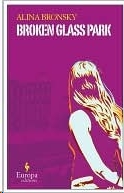
Sascha’s quest for normalcy is encumbered by what makes an immigrant’s life difficult: prejudices (“I’m sick of having to explain everything from scratch (…) how come I speak German so well – ten times better than all the other Russian Germans put together”), loneliness, elders who cannot help because they do not know how to navigate the system or speak the language (“After almost two years here, Maria’s German is limited to about twenty words, things like bus, potato, butter, trash, boil, wash, and fuck you (…). Occasionally she tries to group her vocabulary into sentences. That usually doesn’t go too well. When she’s shopping anywhere but the Russian grocery store, she has to point to whatever she wants (…). I tried for two weeks to help her master the sentence “I only speak Russian”. She carries it around on a slip of paper in her wallet, transcribed phonetically into Cyrillic letters," lack of opportunity which leads the immigrant youth towards crime.

Sascha stands out in her Russian immigrant community, because she is an orphan, because her mother was murdered (and the Russians being superstitious, she is confronted to even more prejudice instead of being surrounded by love and compassion), and because she is really smart. Sascha becomes the bridge between the native Germans and the “Ghetto Russians”. She will meet Volker the editor of the daily paper that published Vadim’s interview and his sickly son, Felix. Her relationship with Volker is one of the troubling elements of the book .Is it pity for Felix or a normal teenager’s attraction that makes her enter into a sexual relationship with him? When she then makes love with Volker, is it an unconscious search for a father figure? And what is this other Volker, the young 24 year old Nationalist Party member she hands to the Russian youth in Broken Glass Park? Is he supposed to be representing the dark side of Volker the editor in chief? Or should the reader take to heart what she says at the beginning of the book: “I hate men”, because in truth all the men in her life have been bastards?

Broken Glass Park is a coup de maître for a first novel, a book that will not leave the reader indifferent. Sascha’s narrative voice brings out all the complex feelings a teenager exhibits: her life experiences may be more dramatic than the average teenager’s but her internal turmoil is the same, alternating between despair, love for her traumatized siblings, sarcastic humor to survive violence and her mom’s death and keeping dreams alive. My own 16 year old daughter (not an avid reader) devoured it in a week, and THAT is proof enough for me.


* Piter: is the nickname Russians gave to Leningrad. Leningrad was originally St Petersburg, then became Petrograd (Russianized version) at the beginning of World War 1, because the original name sounded too Germanic and the German Empire was the enemy. With Communism's personality cult rising, it became Leningrad (after all Lenin started the Revolution there), even though it was ripped off its "capital city" status (Moscow became again the Capital as it had been until Peter the Great). Piter was the affectionate nickname many Peterburgians used rather than the official Leningrad, a subtle way of rebelling against the regime....

Monday, February 28, 2011

A Literary Treatment of Russia: Part One

Russia has fascinated writers from times immemorial.
Voltaire exchanged quite a copious correspondence with Catherine the Great, whom he called the “Semiramis of the North” and whose authoritarian style he celebrated as much as he admired her war on the Turks.
The Marquis de Custine, a French aristocrat who took to literature and travel to escape scandals, wrote a travelogue in letters, a sort of hybrid of Tocqueville and Montesquieu, called Lettres de Russie. His fascination with the country is comingled with criticism: “Whenever your son is discontented in France, I have a simple remedy: tell him to go to Russia. The journey is beneficial for any foreigner, for whoever has properly experienced that country will be happy to live anywhere else.” He is considered as having more or less predicted the Revolution and beyond: “One day, the sleeping giant will rise and violence end the tyranny of words. Then, equality distraught will summon the old aristocracy in the defense of freedom, only to find that a neglected weapon, raised too late in too idle hands, has lost its strength.”

21st century writers also fall for Russia. The last four books I read gave me an even bigger appreciation of the phenomenon since out of the four authors, two are not Russians: Sam Eastland and James Meek (but Meek has lived in USSR and then the new Russia), David Benioff has a Russian grandfather and the last one, Alina Bronsky, is a Russian “émigré” of the most recent Western Europe-bound immigration wave after the fall of Communism.

Sam Eastland and James Meek tackle the first part of the XX century in USSR. The most fascinating story within Russian history remains the Romanov Drama. Murdered by the Bolsheviks, the Imperial Family laid in the depth of a mining well somewhere outside Ekaterinenburg for decades. Until they were finally unearthed and identified thanks to DNA after the fall of communism, one was never sure of what had really happened to them, especially to the youngest children, Anastasia and the hemophiliac heir to the throne, Alexei Nicolaievitch.

Sam Eastland is of course aware of the latest developments but still manages to keep the reader alert as to what and how it all really happened. His first historical police thriller, The Eye of the Red Tsar, is a page turner, with the unforgettable figure of the Finnish Inspector Pekkala. Incorruptible “Emerald Eye” of the late Nicolai 2, "a man who could not be threatened or beaten or corrupted into surrendering his sense of what was right or wrong", at the beginning of the story - in 1929- Keppala is exiled in the Gulag and is brought back to civilization by a young commissar, on Stalin’s orders. Stalin is the Red Tsar and he only fears one person, Keppala. The structure of the book, with alternating chapters that tell the reader about Keppala’s past as the second son of a Finnish undertaker and as the “Emerald Eye” while the plot develops around a potential survivor of the Ekaterinenburg massacre, makes for an entertaining read. However, I doubt Sam Eastland’s writing style will ever attain the depth and the elegance of Russian author, Boris Akunin, whose heroic policeman Erast Fandorin remains one of my favorites. The problem lies probably in the fact that Sam Eastland does not master Russian Literature and History as much as native Bakunin (whose real name is Grigory Chkhartishvili.) This latter author's pseudonym pun on celebrated anarchist Bakunin -in his use of the initial B.(for Boris) Akunin- already informs the reader of more delectable literary and culturally connected surprises to come.

In that respect, James Meek’s The People’s Act of Love is a superbly written book, a strong book, a book set in the past – 1919 in USSR, at the time of the Civil War in Siberia- but that is at the same time very contemporary in its writing. The author focuses exclusively on place, characters and storyline. And what a storyline: the convergence of four principal characters, Anna, Samarin, Balashov and Mutz, each with a different point of view, at a time when the world was taking a new shape! Anna “did not believe in new worlds, but she could not help wanting to be with men and women who did.” Samarin, an escaped political prisoner, [calls himself] “the destruction (…) of everything that stands in the way of the happiness of the people who will be born after I'm dead. (…) A manifestation. Of present anger and future love.” The Christian mystic Balashov leads a sect that is seeking paradise on earth through castration and Mutz, a junior officer of the Czech Legion, simply wants to leave Siberia taking Anna with him. I will not reveal all the twists and turns of this fabulous novel, but cannot help but ask myself the following question: what constitutes a people’s act of love? Is it an act of self-sacrifice to protect the living or an act of destruction, annihilation, for the benefit of future generations? I read this book when it was released in 2005 and am still overwhelmed by it. I also just found out that Johnny Depp bought the rights to produce a movie based on the book. I am both anxious to see it and concerned that the cinematographic treatment of this masterpiece may leave out some of its essence.


To be continued: David Benioff, City of Thieves and Alina Bronsky, Broken Glass Park

Saturday, January 15, 2011

Flowers of Evil

Baudelaire could not have imagined that I would steal the title of his majestic and wonderful poetry book to write about one of my pet peeves.


Flowers of Evil bother me. To the point of repulsion. I have goose bumps, my skin crawls back, nausea invades me, I cannot breathe and sometimes I even develop an immediate headache. This morning, when I stepped into the medical building where my dentist’s office is, the symptoms flared up. I was not totally awaken and was juggling chapka, gloves, bag, book and coffee mug. I still had my sun glasses on coming into a black marble walled foyer from the sparklingly sunny snow patches. I made my way on automatic pilot into the even darker elevator, not noticing anyone or anything.


On the way out, I had my regular glasses on.  The Flowers of Evil hit me right in the face as soon as I got out of the elevator.


Tall ivy plastic trees, almost unnamable exotic plastic plants, plastic ferns and foliage of sorts. Or should I say dust gatherers, allergy enhancers, BPA releasers, toxic fumes slow producers?

I wonder if anyone has taken up the fight against these Flowers of Evil yet. What purpose do they serve? Beautification?  Interior Decoration? Soothing you into a hypnotic zone before you get your teeth drilled, your breast mammogrammed, your skin cancer removed?  What is their carbon foot print? What is their long term health damage? Where are they made? What about the workers’ health?

Tuesday, January 4, 2011

Ecological Epiphany

Voltaire wrote in Candide: "Il faut cultiver son jardin."


It takes time to understand the core meaning of this sentence. Of course witty Voltaire did not mean it for us to literally dig and plant and weed and harvest our garden, nor did he encourage us to live off the fat of the land. That would be his archnemesis' fashion, le cher Jean-Jacques the philosophizing Tartuffe himself.
But Voltaire's beau mot became my motto as I compared my front and back gardens, took notice of sun and shadow, surveyed the terrain and calculated the optimal sun exposure per day per week per month and per season... all with the aim of becoming a "gentlewoman-farmer", or rather an "urban food-grower."

At heart I am a country girl who is happier when "playing dirty," with soil under my broken fingernails, mud on my toes, and the sun my only cosmetic. Long walks in the woods, observing birds and bears, finding praying mantises, spotting fish jumping out ot the lake or animal tracks, and learning the name of trees and plants bring me the sort of pleasure Teresa of Avila enjoyed in her Ecstasy. In Nature I find peace, I find myself and I find God.

It took me  years to come to terms with this aspect of my personality. Years and a few good books. Maybe it's age after all, or all those Montaigne's Essays we were forced to read and explain when we were in High School, or the perusing of thinkers and writers like Thoreau and his Walden, Rudolf Steiner's The Agriculture Course, Annie Dillard and her Pilgrim at Tinker Creek, Barbara Kingsolver and her self-sufficient year she describes in Animal, Vegetable, Miracle and more recently Michael Pollan's The Omnivore's Dilemna and In Defense of Food, which I read after screening Food, Inc. Recently I also stumbled upon Wendell Berry's poems and other writings, which may have been just what I needed to finalize my education and who could be considered as a Walden-Steiner combination with an Amish twist and a few other tricks up his sleeve.

If I dig into my youth, I can already detect the first filaments of what my daughter calls "Mom's inner hip-hippie-peacenik-side." Tolstoy was my favorite writer from the moment I read War and Peace.  When I read Anna Karenina, especially Part 3, Chapter 4 in which Levine cuts the hay with a scythe along with the peasants, I became convinced that for the Earth to survive, it would be necessary to put a brake on progress, to slow down instead of to constantly grow. Decrease, not increase. Save, not spend. Make, not buy. I felt like a prophet in the desert for the next 30 years...

My ecological epiphany never left me, although I toned down my enthusiastic declarations of ecological independence and refrained from writing more Constitutions of the United States of the Earth. Somehow, my fellow-citizens and college mates thought I was just a jester, another fool in the realm of dreams, living in the kingdom of Chimera CSA.  Now, they are all joining their own CSAs, brag about the bounty of their weekly basket and the benefits of biodynamic agriculture. I am so happy they finally saw the light that I do not waver my finger at them in an "I-told-you-so" gesture, neither do I claim my 5 minutes of recognition.

But now at almost 50, I can accept my "inner hippie self," I can cheer for my little organic garden and its humongous harvest,  I can relish in my home-made pickled chili peppers, pickled cucumbers, jams and cookies, I can support my CSA which brings my family the biodynamic dairy and animal products I cannot provide. Yet.


Top right: Photo of my garden at the beginning of June 2010
Bottom left: Photo of my first harvest, first week of July 2010.

Sunday, January 2, 2011

The King's Speech... A Review of an Oscar Material Movie!

All families keep secrets: bastard children, misalliances, mistresses or mistreatments, dishonor or disease… And no one is immune, as revealed by the very moving film, The King’s Speech which brings out into the open George VI’s debilitating stammer.


The most important moment in the movie comes when “Bertie” (Albert is the first name of the man who will become King George VI) reveals that he was an abused child. Abused by his nanny, Mary Peters; humiliated by his dad and his elder brother (who will abdicate the throne for Nazi sympathizer American divorcee Wallis Simpson), his stammer comes as no surprise and a surprise nonetheless. In the 30s, the wireless broadcast communications became the new means by which politicians addressed the crowds. A stammer, a stutter, a lisp or any form of speech impediment could undo a career. How many movie stars of the early cinema whose voices were never heard had to abandon all hope of pursuing a “talking” career once cinema discovered sound?… But a King could not simply call it quits.

Edward VIII did not in fact abdicate purely for the love of Wallis Simpson. Had the woman not been such an ardent Nazi sympathizer, maybe the Cabinet and the Church of England would have closed their eyes on her twice-divorced status. After all, didn’t King Henry VIII separate from the Catholic Church to divorce and marry… multiple times? George VI had no intention to become a King and was not trained to become one. As the younger brother, extremely shy and with his speech impediment, he was looking towards an ordinary, albeit wealthy and aristocratic, family life. Confronted with unexpected circumstances, he showed great courage as he would later on during World War 2.

Colin Firth plays an admirable and convincing George VI. I was amazed at how he learned the King’s stammer. It must be extremely difficult for an actor to master a stammer when one is not so impaired. But then it is an actor’s job to be able to act…Geoffrey Rush in the part of formidable Ryan Logue who helps George VI is simply brilliant: an Australian “nobody” as the soon-to-be King George VI calls him once, he was not a medical doctor, nor a certified speech therapist. His gift, because that is what it truly was, was to be able to bring out the best in people. WW1 soldiers whom he helped find their voices again after the traumas they endured in the trenches or Bertie/George VI, he considered all men equal in front of adversity. His mix of tongue twisters/breath exercises and yes, psychotherapy, got to the root(s) of the future King’s speechlessness. Both actors will probably be nominated for Best Actor and Best Supporting Actor.

David Seidler, the scriptwriter, was also a stutterer when he grew up. He remembers having listened to the King’s slowly enunciated war speeches on the radio while a child in England. The idea of a movie on George VI was always in the back of his mind. He met with Ryan Logue's only surviving son. The project went on hold in the early 1980s when the Queen Mom (George VI's widow) asked him not to go forward while she was still alive. Little did he know he’d have to wait for so long: she lived up to the age of 102!

What strikes the spectator though at the end of the movie is the current Royal Family’s misplaced pride: if this “secret” had been exposed earlier, it would have made the House of Windsor appear more humane, less remote, less imbued with itself, with convention, appearance and history. Maybe they would have done something for Prince Charles’ ears?

The original King's Speech can be found at: http://www.youtube.com/watch?v=DAhFW_auT20

Saturday, January 1, 2011

RESOLUTIONS

On this, the first day of Anno Domini 2011:

Resolve in no other order than what comes first to my brain:

- To look at life through a pink lense always and forever
- To get my invalidating lumbar spinal stenosis and left knee sorted out
- To run again even if it means getting a corticoid injection every month
- To acquire US citizenship
- To trust my children
- To encourage my children to become independent
- To support my children's decisions regarding their own life without regret or bitterness
- To read more
- To learn a new language
- TO WRITE and deliver these lines trotting inside of me
- To love unconditionally
- To forgive and not judge
- To make better use of my time and of my hands, cooking, cross-stitching or sketching
- To laugh
- To sing
- To play the piano again
- To learn how to make brioche
- To be in constant and silent prayer
- To get rid of moral and physical clutter
- To live


What is a heart if the flower of love is not growing inside it?

Picture taken at Deep Creek Lake, Maryland, November 2010.

Wednesday, December 1, 2010

L'Angoisse du Lecteur

Non, ce n’est pas le titre d’un roman… Tout le monde a entendu parler de la fameuse “angoisse de la page blanche” qui atteint l’écrivaillon comme l’auteur le plus prolifique… Ce rectangle blanc et qui le demeure alors que l’inspiration fuit, la muse s’amuse, et la peur s’installe de ne plus être capable d’écrire, de créer. Eh bien, j’ai découvert cet été que la même chose peut arriver au lecteur le plus avide qui soit… Impossibilité de lire, de penser même à lire, de regarder un livre. Angoisse existentielle dans mon cas.


En général, je lis toujours trois, voire quatre livres en même temps. Français, américain, russe, de la littérature –beaucoup de romans mais aussi beaucoup de nouvelles et de poésie-, mais aussi des essais, ce que l’on appelle ici de la « non fiction ». Selon l’humeur, je passe de l’un à l’autre en une soirée ou je reste sur le même jusqu’à la fin. Alors comment puis-je expliquer cette angoisse du lecteur qui m’a saisie cet été ?

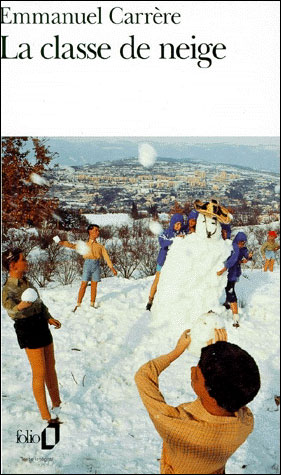
J’ai commencé le mois de juillet en empilant sur ma table de chevet tous les livres que je me promettais – et me réjouissais- de lire d’ici la fin septembre. Plus fourmi que cigale, j’emmagasine les lectures pendant les mois creux, sans « book club ». J’ai donc attaqué début juillet : Un roman russe, d’Emmanuel Carrère. Un peu en retard me direz-vous, le livre a déjà trois ans. Mais pour lire Emmanuel Carrère, il ne faut pas être trop fragile et je l’avais donc laissé de côté jusqu’à ce que je me sente assez forte, l’expérience de La moustache, de L’adversaire et de La classe de neige m’ayant laissée plutôt déprimée. Malheureusement, de roman « russe » avec grand élan, grands espaces et personnages hors du commun, il n’en est point, si ce n’est le fantôme de son grand-père (le père d’Hélène Carrère d’Encausse), un Géorgien arrivé en France comme les Russes Blancs, juste après la Révolution bolchevique, et qui ne trouvera jamais sa place dans la société française. A tel point qu’il disparait, à la fin de la Deuxième Guerre, pour faits de collaboration. Fusillé ? Pendu ? Renvoyé en URSS par l’entremise d’un Parti Communiste français passé à la Résistance seulement quand Hitler envahit l’URSS et de ce fait, envoyé pourrir au Goulag? Ce fantôme familial, squelette dans le placard de l’académicienne, linge sale dont on ne parle même pas en famille, est-il vraiment à l’origine d’une dépression intergénérationnelle ? Emmanuel Carrère est certes un déprimé permanent (Je l’ai rencontré en 2000… il était déjà fort sombre) et il en devient violent, abusif, jusque dans ses relations intimes qu’il dévoile sans aucune pudeur ni aucun remords, une première fois dans une nouvelle digne de Houellebecq pour le style, publiée dans Le Monde, et qui devient le centre de ce « roman russe », et une deuxième fois dans le roman même. Un tel nombrilisme donne envie de vomir, à croire que ce roman avait comme seul but originel celui d’auto-thérapie. Ni Docteur Jivago, ni Levine, ni Pierre Bezoukhov, ni Raskolnikov, ni même un des frères Karamazov – Aliocha, par exemple-, Emmanuel Carrère a encore de quoi remplir des pages de sa relation avec sa mère, avec son grand-père qu’il n’a pas connu, et avec l’histoire de France et de la Russie. Je doute qu’il ne guérisse d’un spleen que le milieu mondain dans lequel il sévit, entretient volontiers, et qu’il cultive lui-même avec une minutie qui relève de la préméditation.

Il y avait de quoi sortir profondément déprimée de ce livre. Ce fut non seulement le cas, mais ce livre eut pour autre effet de me dégoûter de la lecture. La vue d’un livre m’inspirait l’horreur et toute ma pile de livres à lire pendant l’été se recouvrit de poussière…


Je ne dus mon salut qu’à la Bande Dessinée ! Et, pour bien faire, à deux bandes dessinées particulièrement tristes : la biographie d’Anne Frank (The Anne Frank House Authorized Graphic Biography, by Sid Jacobson and Ernie Colon, aussi connus pour leur très émouvant : The 9/11 Report : A Graphic Adaptation), mais qui, malgré toute l’horreur de la guerre, de ce qui est arrivé à Anne Frank, à sa famille, ne fait pas dans l’exhibitionnisme à la Emmanuel Carrère ; et Stitches : A Memoir, by David Small, où là aussi douleurs personnelles et familiales sont exposées de manière pudique, avec un dessin presque anonyme.

Il m’a fallu deux mois pour surmonter cette angoisse du lecteur, un véritable état de choc du lecteur, de la mi-juillet à la mi-septembre. Deux mois qui ont semblé vraiment très longs au « bookworm » que je suis naturellement. Comme dit le proverbe : « La plume est plus forte que l’épée ». Emmanuel Carrère ne saura vraisemblablement jamais combien la lecture de l’écriture égoïste et mortifère de son « roman russe » m’aura empoisonné l’âme le temps d’un été.